 Math101 · Independent Ontario learning library
 Math101learn.math101.ca
Derivative
A derivative measures instantaneous rate of change and gives the slope of a function at a point.
The derivative tells us how quickly a function is changing right now.
Two views of one idea
For $y=f(x)$, the derivative $f'(a)$ is both
- the slope of the tangent line to the graph at $x=a$; and
- the instantaneous rate of output change with respect to input at $x=a$.
A graph's slope is a visual way of seeing a rate.
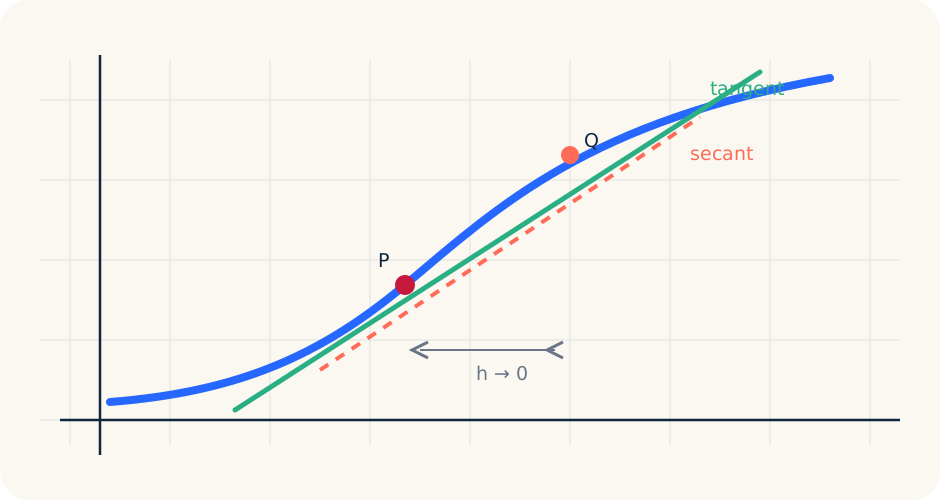
From average to instantaneous
Between $x=a$ and $x=a+h$, the average rate of change is
This is a secant slope. Let the second point approach the first:
First principles: $f(x)=x^2$
At $x=3$, $f'(3)=6$. The tangent slope to $y=x^2$ at $(3,9)$ is $6$.
Notation
| Notation | Meaning |
|---|---|
| $f'(x)$ | derivative of a function named $f$ |
| $y'$ | compact derivative notation |
| $dy/dx$ | derivative of $y$ with respect to $x$ |
| $d/dx[f(x)]$ | apply the derivative operator to $f(x)$ |
“With respect to $x$” identifies which input is changing.
Units
Derivative units are output units divided by input units. If position $s(t)$ is in metres and time in seconds, $s'(t)$ is in metres per second. The second derivative $s''(t)$ is acceleration in metres per second squared.
Efficient differentiation
The definition explains the idea. Rules calculate derivatives efficiently. The power rule is
More complicated functions use the Product Rule, Quotient Rule, and Chain Rule.
Interpreting the sign
- $f'(x)>0$: the function is increasing.
- $f'(x)<0$: the function is decreasing.
- $f'(x)=0$: the tangent is horizontal, but the point is not automatically a maximum or minimum.
A zero derivative identifies a critical-point candidate. The surrounding behaviour decides its type.
When a derivative does not exist
Nearby slopes must approach one finite value. Corners, cusps, vertical tangents, and discontinuities can prevent differentiability.
For example, $f(x)=|x|$ is continuous at zero but not differentiable there: left slopes approach $-1$ and right slopes approach $1$.
Common mistakes
Applications
Derivatives describe velocity, acceleration, marginal cost, growth rate, sensitivity, optimization, and how small input changes affect an output.
Related topics
Explore the idea
Tangent and accumulation explorer
Change one quantity at a time and connect what moves to Derivative.
Try it yourself
Hints are part of learning. Open one whenever it makes the next step feel possible.
For f(x) = x², find f′(3).
- f′(x) = 2x
- f′(3) = 2(3)
- f′(3) = 6
Differentiate f(x) = 3x² − 2x + 4.
- d/dx(3x²) = 6x
- d/dx(−2x) = −2
- d/dx(4) = 0
- f′(x) = 6x − 2
End of lesson
Nice work making it this far.
Understanding grows through return visits. Save this lesson, try the practice, or continue when you are ready.
