 Math101 · Independent Ontario learning library
 Math101
Derivative
A derivative measures instantaneous rate of change and gives the slope of a function at a point.
The derivative tells us how quickly a function is changing right now.
Two views of one idea
For $y=f(x)$, the derivative $f'(a)$ is both
- the slope of the tangent line to the graph at $x=a$; and
- the instantaneous rate of output change with respect to input at $x=a$.
A graph's slope is a visual way of seeing a rate.
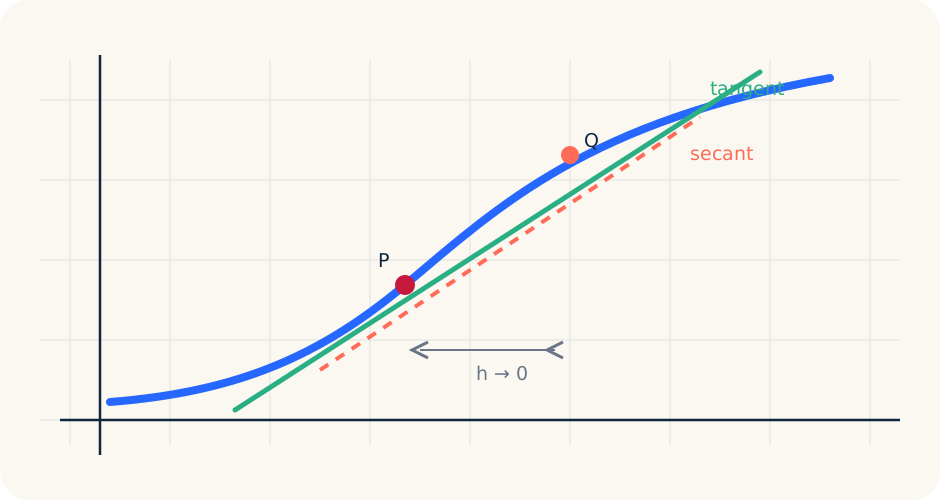
From average to instantaneous
Between $x=a$ and $x=a+h$, the average rate of change is
$$
\frac{f(a+h)-f(a)}h.
$$
This is a secant slope. Let the second point approach the first:
$$
f'(a)=\lim_{h\to0}\frac{f(a+h)-f(a)}h.
$$
Notation
| Notation | Meaning |
|---|---|
| $f'(x)$ | derivative of a function named $f$ |
| $y'$ | compact derivative notation |
| $dy/dx$ | derivative of $y$ with respect to $x$ |
| $d/dx[f(x)]$ | apply the derivative operator to $f(x)$ |
“With respect to $x$” identifies which input is changing.
Units
Derivative units are output units divided by input units. If position $s(t)$ is in metres and time in seconds, $s'(t)$ is in metres per second. The second derivative $s''(t)$ is acceleration in metres per second squared.
Interpreting the sign
- $f'(x)>0$: the function is increasing.
- $f'(x)<0$: the function is decreasing.
- $f'(x)=0$: the tangent is horizontal, but the point is not automatically a maximum or minimum.
A zero derivative identifies a critical-point candidate. The surrounding behaviour decides its type.
