 Math101 · Independent Ontario learning library
 Math101learn.math101.ca
Definite Integral
A definite integral measures signed accumulation over an interval and can be evaluated using antiderivatives.
The definite integral $\int_a^b f(x)\,dx$ is the net accumulation of $f$ from $a$ to $b$.
What it measures
If $f$ is a rate, its integral gives accumulated change. On a graph, it gives signed area: regions above the $x$-axis count positively and regions below count negatively.
Riemann-sum definition
when the limit exists. The $dx$ identifies the variable and reflects the widths being accumulated.
Fundamental Theorem of Calculus
If $F'(x)=f(x)$, then
This connects accumulation with derivatives and turns a limiting sum into an antiderivative calculation.
Worked example
Signed area versus total area
The total geometric area is $1$, not $0$. To find total area, split where the function changes sign or integrate $|f(x)|$.
Useful properties
and
Units
Integral units are output units times input units. Velocity in metres per second integrated over seconds gives displacement in metres.
Common mistakes
Applications
Integrals recover displacement from velocity, total mass from density, probability from a density function, work from varying force, and total change from a marginal rate.
Related topics
Explore the idea
Tangent and accumulation explorer
Change one quantity at a time and connect what moves to Definite Integral.
Try it yourself
Hints are part of learning. Open one whenever it makes the next step feel possible.
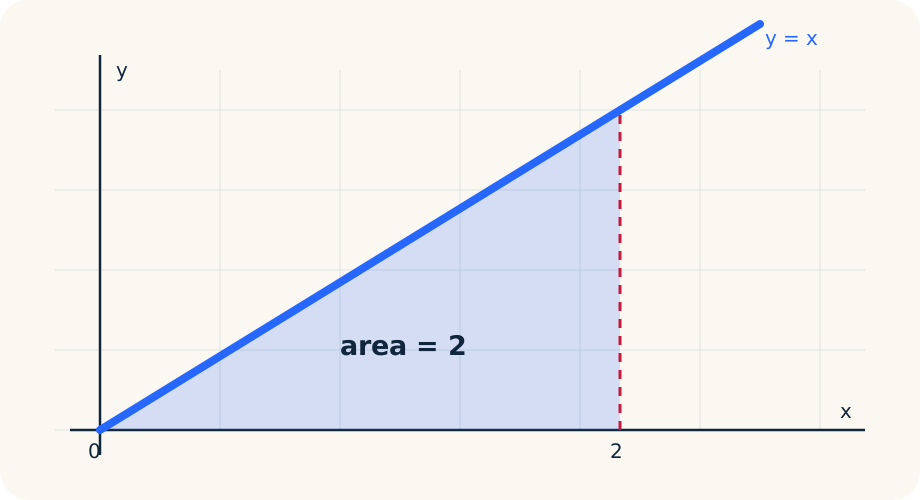
Evaluate ∫₀² x dx.
- ∫ x dx = x²/2
- [x²/2]₀² = 2²/2 − 0²/2
- = 2
End of lesson
Nice work making it this far.
Understanding grows through return visits. Save this lesson, try the practice, or continue when you are ready.
