 Math101 · Independent Ontario learning library
 Math101learn.math101.ca
Quadratic Formula
The quadratic formula solves every quadratic equation and reveals how its roots depend on the shape of its parabola.
The quadratic formula solves any equation of the form $ax^2+bx+c=0$, where $a\ne0$.
The idea in one minute
A quadratic equation asks where a parabola reaches height zero. Those locations are its roots, zeros, or solutions—three views of the same $x$-values.
Some quadratics factor neatly. Many do not. The quadratic formula works in both cases:
First write the equation in standard form:
Then $a$, $b$, and $c$ are the coefficients, including their signs.
What each part means
| Symbol | Meaning | In $2x^2-7x-4=0$ |
|---|---|---|
| $a$ | coefficient of $x^2$ | $2$ |
| $b$ | coefficient of $x$ | $-7$ |
| $c$ | constant term | $-4$ |
| $\pm$ | use a plus branch and a minus branch | two possible roots |
| $b^2-4ac$ | the discriminant | $81$ |
A visual reading
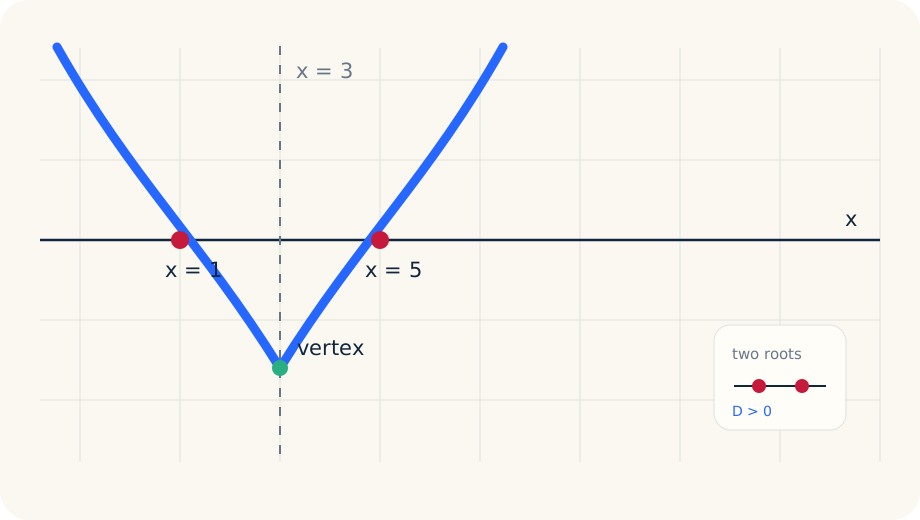
The two outputs are the two places where the parabola crosses the $x$-axis. Their midpoint is $-b/(2a)$, the $x$-coordinate of the vertex. The formula starts at that midpoint and moves an equal distance in the plus and minus directions.
A dependable five-step method
- Rearrange the equation so one side is zero.
- Record $a$, $b$, and $c$ with their signs.
- Calculate the discriminant $D=b^2-4ac$.
- Substitute into $x=(-b\pm\sqrt D)/(2a)$.
- Simplify both branches and check when practical.
Writing the coefficient list before substituting prevents most avoidable errors.
Worked example: two rational roots
Worked example: an irrational answer
The discriminant predicts the graph
| Value of $D=b^2-4ac$ | Real roots | Parabola |
|---|---|---|
| $D>0$ | two distinct roots | crosses the axis twice |
| $D=0$ | one repeated root | touches the axis once |
| $D<0$ | no real roots | does not meet the axis |
When complex numbers are allowed, a negative discriminant gives two complex conjugate roots. “No real roots” is therefore more precise than “no solution.”
Why the formula works
Begin with $ax^2+bx+c=0$ and divide by $a$:
Complete the square by adding $(b/2a)^2$ to both sides:
Take both square roots and isolate $x$:
The quadratic formula is Completing the Square applied once to every possible quadratic.
Common mistakes
Choosing a solving method
- Use factoring when the factors are visible.
- Use square roots when the equation looks like $(x-h)^2=k$.
- Use completing the square when vertex form matters.
- Use the quadratic formula when you want a method that always works.
Applications
Quadratics model projectile height, maximum area or revenue, intersection points, and relationships with constant second differences. The two roots can represent two times, two positions, or two possible dimensions. Context decides whether both answers are meaningful.
Quick self-check
- Is the equation equal to zero?
- Did I keep every coefficient sign?
- Did I calculate the discriminant separately?
- Is the entire numerator over $2a$?
- Did I use both branches?
- Does substitution or the graph support the result?
Related topics
Try it yourself
Hints are part of learning. Open one whenever it makes the next step feel possible.
For x² − 6x + 5 = 0, which values should be used for a, b, and c?
- The coefficient of x² is 1, so a = 1.
- The coefficient of x is −6, so b = −6.
- The constant is 5, so c = 5.
Find the discriminant of x² − 6x + 5 = 0.
- b² − 4ac = (−6)² − 4(1)(5)
- = 36 − 20
- = 16
Use the quadratic formula to find the larger root of x² − 6x + 5 = 0.
- x = (6 ± √16)/2
- x = (6 ± 4)/2
- The larger root is (6 + 4)/2 = 5.
What does a discriminant of −12 tell you about the real roots?
- The discriminant is the expression under the square root.
- Because −12 is negative, its square root is not real.
- Therefore the quadratic has no real roots.
End of lesson
Nice work making it this far.
Understanding grows through return visits. Save this lesson, try the practice, or continue when you are ready.
