 Math101 · Independent Ontario learning library
 Math101learn.math101.ca
Quadratic Equation
A quadratic equation contains a squared variable and asks for the values that make its related parabola reach zero.
A quadratic equation in one variable can be written as $ax^2+bx+c=0$, where $a\ne0$.
What makes it quadratic
The greatest exponent is $2$. Each of these is quadratic:
$$
x^2-5x+6=0,
\qquad 2x^2=7x+4,
\qquad (x-3)^2=16.
$$
They look different, but each can be rearranged into standard form.
Three useful forms
| Form | Expression | Reveals |
|---|---|---|
| standard | $ax^2+bx+c$ | coefficients and $y$-intercept |
| factored | $a(x-r_1)(x-r_2)$ | roots $r_1,r_2$ |
| vertex | $a(x-h)^2+k$ | vertex $(h,k)$ and symmetry |
Solving by factoring
Factoring is efficient when the structure is visible. It is not the only valid method.
Solving by square roots
Methods that always extend
Any quadratic can be converted to vertex form by Completing the Square. That same process produces the Quadratic Formula:
$$
x=\frac{-b\pm\sqrt{b^2-4ac}}{2a}.
$$
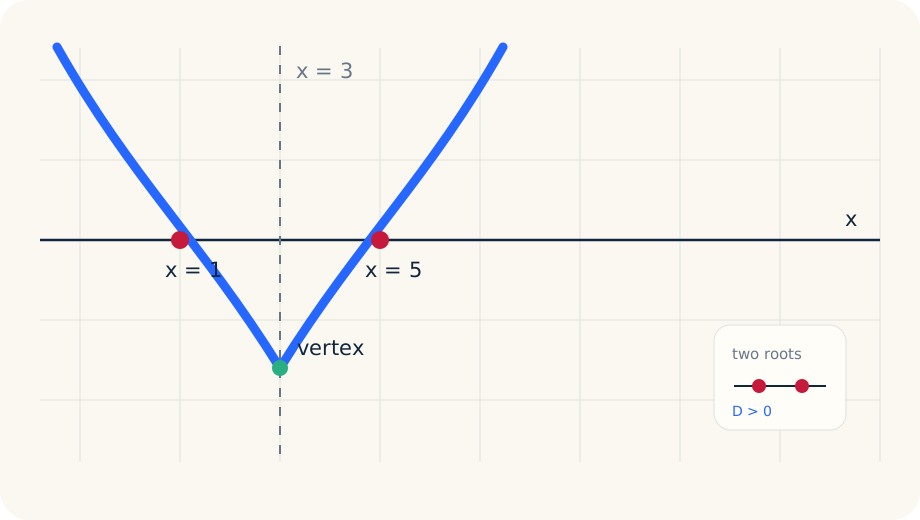
The discriminant $D=b^2-4ac$ predicts the real roots:
- $D>0$: two distinct real roots;
- $D=0$: one repeated real root;
- $D<0$: no real roots.
Choosing a method
- Put the equation in a recognizable form.
- If it is a perfect square, use square roots.
- If it factors readily, factor.
- If vertex information matters, complete the square.
- Otherwise use the formula.
Modelling example
Common mistakes
Related topics
Check your understanding
1 practice questionTry it yourself
Hints are part of learning. Open one whenever it makes the next step feel possible.
Question 1Solve by factoring · Gentle
Which pair is the complete solution to x² − 5x + 6 = 0?
Find two numbers that multiply to 6 and add to −5 inside (x − ?)(x − ?).
- x² − 5x + 6 = (x − 2)(x − 3)
- Set each factor equal to zero.
- x = 2 or x = 3.
End of lesson
Nice work making it this far.
Understanding grows through return visits. Save this lesson, try the practice, or continue when you are ready.
