 Math101 · Independent Ontario learning library
 Math101learn.math101.ca
Pythagorean Theorem
In a right triangle, the area of the square on the hypotenuse equals the combined areas of the squares on the legs.
In every right triangle, the square of the hypotenuse equals the sum of the squares of the legs.
The relationship
$a$ and $b$ label the legs, which form the right angle. $c$ labels the hypotenuse, opposite the right angle and always the longest side.
Why the sides are squared
The theorem compares areas. Build a square on each side of a right triangle: the large square on the hypotenuse has the same area as the other two combined.
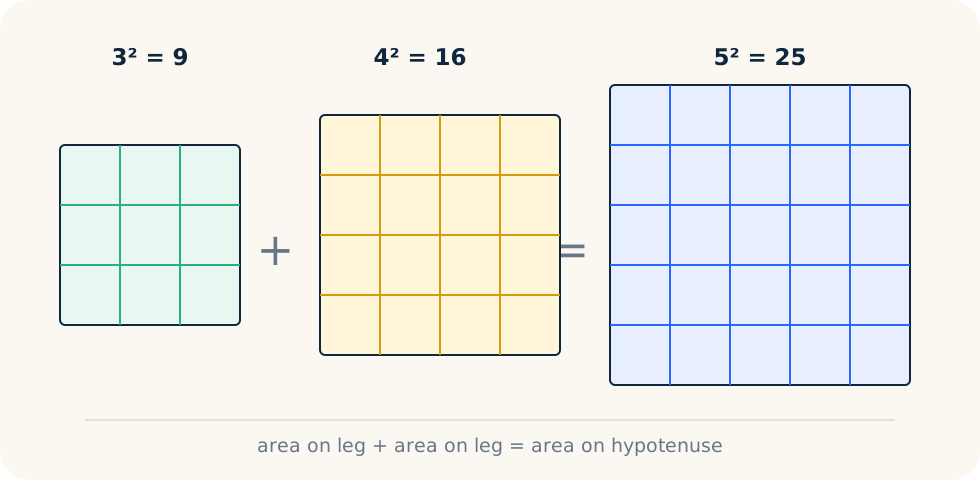
For a $3$–$4$–$5$ triangle,
Finding a hypotenuse
Finding a missing leg
When the hypotenuse is known, subtract the known leg-square from $c^2$.
The converse
The relationship also tests whether a triangle is right.
For $7$, $24$, and $25$:
so the triangle is right.
Distance on a coordinate plane
Horizontal and vertical changes form perpendicular legs. The direct distance is
which is the Distance Formula.
Applications
The theorem finds screen diagonals, ladder heights, construction diagonals, vector lengths, and distances between coordinates. Whenever perpendicular directions combine into one direct distance, a right triangle is nearby.
Common mistakes
Self-check
- Is the triangle right?
- Which side is opposite the right angle?
- Is my hypotenuse the longest value?
- Did I take the square root at the end?
- Did I include units?
Related topics
Explore the idea
Geometry measurement
Change one quantity at a time and connect what moves to Pythagorean Theorem.
Try it yourself
Hints are part of learning. Open one whenever it makes the next step feel possible.
A right triangle has legs 6 and 8. Find the hypotenuse.
- c² = 6² + 8²
- c² = 36 + 64 = 100
- c = √100 = 10
A right triangle has hypotenuse 13 and one leg 5. Find the other leg.
- b² = 13² − 5²
- b² = 169 − 25 = 144
- b = √144 = 12
End of lesson
Nice work making it this far.
Understanding grows through return visits. Save this lesson, try the practice, or continue when you are ready.
