 Math101 · Independent Ontario learning library
 Math101
Pythagorean Theorem
In a right triangle, the area of the square on the hypotenuse equals the combined areas of the squares on the legs.
In every right triangle, the square of the hypotenuse equals the sum of the squares of the legs.
The relationship
$$
a^2+b^2=c^2
$$
$a$ and $b$ label the legs, which form the right angle. $c$ labels the hypotenuse, opposite the right angle and always the longest side.
Why the sides are squared
The theorem compares areas. Build a square on each side of a right triangle: the large square on the hypotenuse has the same area as the other two combined.
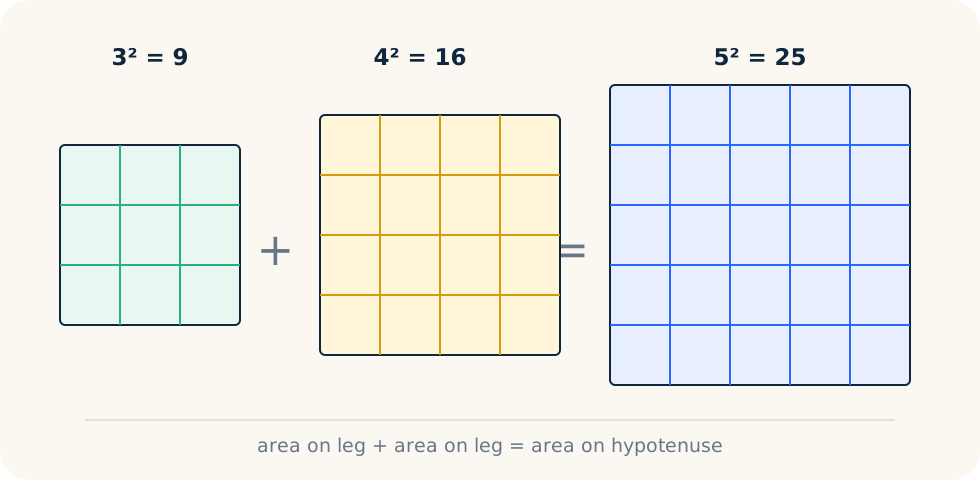
For a $3$–$4$–$5$ triangle,
$$
3^2+4^2=9+16=25=5^2.
$$
Finding a hypotenuse
Finding a missing leg
When the hypotenuse is known, subtract the known leg-square from $c^2$.
Common mistakes
Self-check
- Is the triangle right?
- Which side is opposite the right angle?
- Is my hypotenuse the longest value?
- Did I take the square root at the end?
- Did I include units?
