 Math101 · Independent Ontario learning library
 Math101learn.math101.ca
Adding Fractions
Add fractions by expressing them in equal-sized parts, combining the numerators, and simplifying.
Fractions can be added when they describe pieces of the same size.
The central idea
In $3/4$, the denominator $4$ says the whole is divided into four equal parts. The numerator $3$ says three of those parts are selected.
If two fractions already have the same denominator, their pieces match:
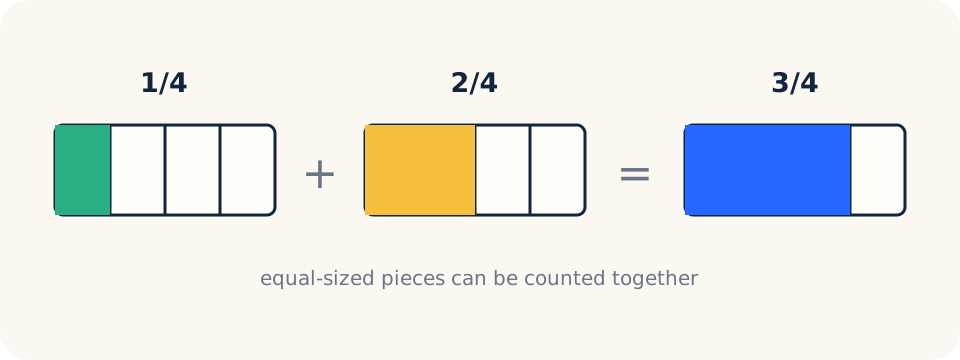
Like denominators
For a common denominator $d$,
Unlike denominators
We cannot directly combine halves and thirds because the pieces have different sizes. First rename both fractions using a common denominator.
Multiplying a numerator and denominator by the same nonzero number does not change the fraction's value. It only changes the name of its pieces.
A reliable method
- Check whether the denominators match.
- If not, choose a common denominator—preferably the least common multiple.
- Rewrite each fraction as an equivalent fraction.
- Add the numerators and keep the common denominator.
- Simplify the result.
Example with simplification
A sum greater than one
Improper fractions are valid answers. Whether $3/2$ or $1\tfrac12$ is more useful depends on the context.
Estimate before calculating
An estimate catches errors. The sum $7/10+4/9$ is a little more than $0.7+0.4=1.1$. An answer near $0.1$ cannot be reasonable.
Common mistakes
Self-check
- Are the pieces the same size before I add?
- Did I create equivalent fractions correctly?
- Did I add only the numerators?
- Can the final fraction be simplified?
- Is the size of the answer reasonable?
Related topics
Try it yourself
Hints are part of learning. Open one whenever it makes the next step feel possible.
Calculate 1/4 + 2/4.
- The denominators already match.
- Add the numerators: 1 + 2 = 3.
- 1/4 + 2/4 = 3/4.
End of lesson
Nice work making it this far.
Understanding grows through return visits. Save this lesson, try the practice, or continue when you are ready.
