 Math101 · Independent Ontario learning library
 Math101
Unit Circle
The unit circle turns every angle into a point whose coordinates are cosine and sine.
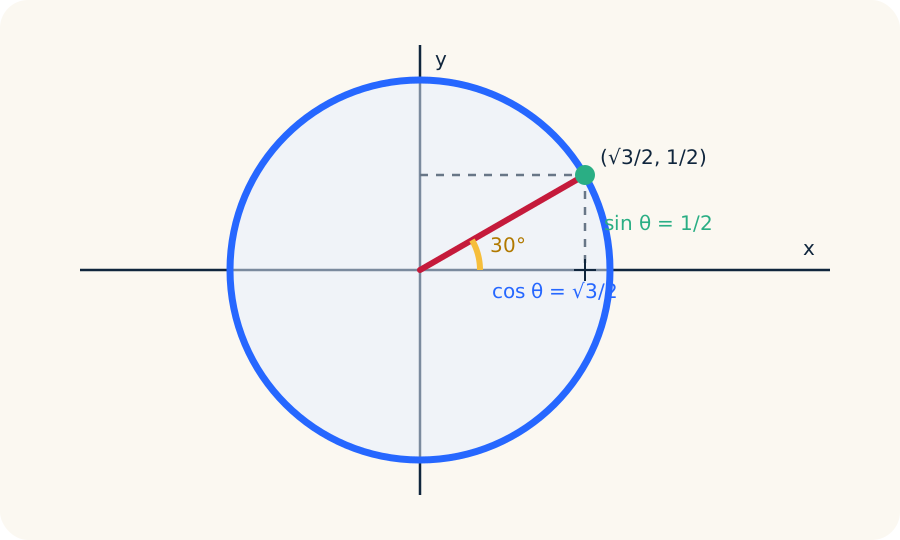
On the unit circle, the point reached by an angle $\theta$ is $(\cos\theta,\sin\theta)$.
One circle organizes trigonometry
The unit circle has centre $(0,0)$ and radius $1$:
$$
x^2+y^2=1.
$$
Begin at $(1,0)$ and rotate counterclockwise through $\theta$. The endpoint is
$$
(x,y)=(\cos\theta,\sin\theta).
$$
Cosine is horizontal; sine is vertical.
The triangle connection
Drop a vertical line from the circle point to the $x$-axis. The right triangle has hypotenuse $1$, horizontal leg $x$, and vertical leg $y$:
$$
\cos\theta=\frac{x}{1}=x,
\qquad
\sin\theta=\frac{y}{1}=y.
$$
The Pythagorean Theorem gives
$$
\cos^2\theta+\sin^2\theta=1.
$$
First-quadrant anchor angles
| Degrees | Radians | $\cos\theta$ | $\sin\theta$ |
|---|---|---|---|
| $0^\circ$ | $0$ | $1$ | $0$ |
| $30^\circ$ | $\pi/6$ | $\sqrt3/2$ | $1/2$ |
| $45^\circ$ | $\pi/4$ | $\sqrt2/2$ | $\sqrt2/2$ |
| $60^\circ$ | $\pi/3$ | $1/2$ | $\sqrt3/2$ |
| $90^\circ$ | $\pi/2$ | $0$ | $1$ |
Sine rises from $0$ to $1$; cosine uses the same values in reverse.
Signs by quadrant
| Quadrant | Coordinate signs | Positive functions |
|---|---|---|
| I | $(+,+)$ | sine and cosine |
| II | $(-,+)$ | sine |
| III | $(-,-)$ | neither sine nor cosine |
| IV | $(+,-)$ | cosine |
Tangent is $\sin\theta/\cos\theta$, so it is positive when the coordinates share a sign.
