 Math101 · Independent Ontario learning library
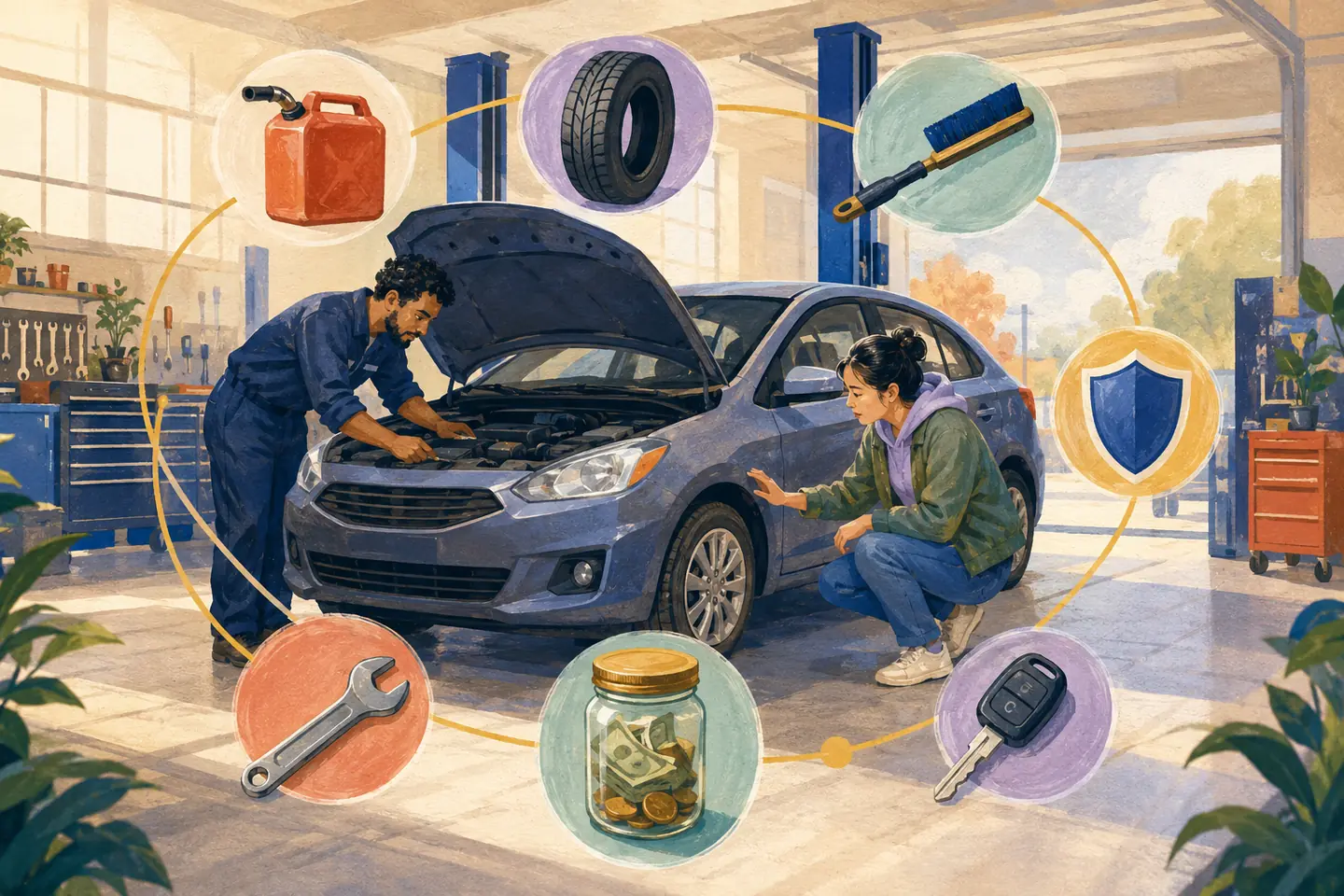
The purchase price is not the car budget
Calculate a 12-month ownership cost:
- purchase/down payment or finance/lease payments;
- sales tax and registration/transfer costs;
- insurance premium and financing-related coverage requirements;
- fuel or charging;
- home, campus and work parking;
- oil/service, brakes, filters and scheduled maintenance;
- seasonal tires, wheels, storage and changeovers;
- repairs and roadside assistance;
- interest and end-of-term obligations for financing/leasing;
- future replacement.
Divide annual costs by 12, but keep cash available when a cost arrives. A CAD 3,000 repair does not accept “CAD 250 per month on paper” unless the reserve exists.
Get insurance quotes first
Ontario requires automobile insurance before a vehicle is registered for road use. FSRA recommends shopping and comparing at least three quotes. Give each insurer the same accurate information:
- exact vehicle/VIN where available;
- all licensed household drivers and regular drivers;
- home address and where the car is kept;
- daily commute and annual distance;
- school/work/business or delivery use;
- licence history, training, convictions and claims;
- requested coverage, limits and deductibles.
Misrepresentation or omitted drivers/use can raise rates, cancel coverage or undermine a claim. Ask what changes must be reported later.
Compare more than price: liability limit, accident benefits, collision/comprehensive, deductibles, loss-of-use, endorsements and service. A lender may require additional coverage.
Used-car verification sequence
Ontario’s used-vehicle guide tells buyers to obtain/review the Used Vehicle Information Package (UVIP), including lien/debt information. Use this sequence:
- Meet the seller and compare name with permit/ID appropriately.
- Inspect the physical VIN in more than one location and match all documents.
- Review UVIP history, owners, odometer information and liens.
- Examine service records and recall information.
- Test drive in varied conditions if licensed/insured to do so.
- Pay an independent trusted mechanic for a pre-purchase inspection.
- Obtain an insurance quote using the exact vehicle.
- Use a signed, dated bill of sale with required details.
- Do not send a deposit to “hold” an unverified vehicle.
Judgment: an inspection fee is small compared with buying a major hidden defect. Walk away if the seller blocks verification.
What a safety certificate does—and does not do
An Ontario Safety Standards Certificate confirms that the vehicle met minimum safety standards at inspection. Ontario explicitly says it is not a warranty or guarantee of condition. A used vehicle can pass minimum standards and still need expensive maintenance soon.
Ontario’s current process uses licensed DriveON Vehicle Inspection Centres, and a certificate is generally valid for 36 calendar days. Check the exact registration situation and current rules.
Transfer and registration
Ontario says a buyer must register as the new owner within six days of purchase. Required items generally include proof of insurance, Ontario driver’s licence, UVIP/bill of sale, permit transfer portion, odometer information and a safety certificate where applicable. Confirm current requirements and ServiceOntario location before attending.
Do not drive on the seller’s plates or assume insurance transfers automatically. Plates stay with the seller in Ontario.
Financing questions
Before signing:
- What is the total amount financed?
- What is the annual percentage rate and total cost of borrowing?
- How many payments and what frequency?
- Is any warranty, loan insurance or add-on optional?
- Are there administration, registration or early-payment terms?
- What happens after missed payments or total loss?
Focus on total cost, not “only CAD X biweekly.” A long loan can keep a borrower owing more than an aging car is worth.
Repair and winter readiness
Create two reserves:
- predictable maintenance/tire fund;
- unexpected repair deductible/emergency fund.
Read the owner’s maintenance schedule. Check fluids, tire pressure/tread, lights and warning indicators. Address safety symptoms promptly. Prepare the Government of Canada’s emergency car kit, adapted for Ontario winter and personal medical needs.
Do not postpone insurance premiums to pay repairs: a lapse creates legal and financial risk. Contact the insurer before a payment problem.
Flat tire or roadside stop: safety first
This is a decision checklist, not a universal tire-change procedure. Vehicles have different lift points, spares and fasteners. Follow the owner’s manual and use roadside help when conditions or instructions are uncertain.
- Reduce speed smoothly, signal and move as far from live traffic as safely possible; avoid a curve, hill crest, soft shoulder or narrow lane.
- Turn on hazard lights, apply the parking brake, put the transmission in Park (or the manual-specified gear), and keep occupants away from traffic.
- If the vehicle cannot reach a safe place, there is a collision/injury, or anyone is exposed to fast traffic, call 911 and follow dispatcher/police direction.
- Assess darkness, weather, ground stability and traffic. If any is unsafe, stay in the safer protected location and call roadside assistance; do not stand beside the traffic-facing side.
- Only attempt a change when the owner’s manual confirms the vehicle has the correct usable spare, jack, tools, lift points and sequence—and the location is level, firm and safely separated from traffic.
- Never go under a vehicle supported only by its emergency jack. After installation, follow the manual’s spare-tire speed/distance, pressure and wheel-fastener/torque follow-up instructions, then arrange proper repair.
Before a trip, locate the manual, spare/inflator kit, jack points and roadside-assistance number. The Ontario MTO Driver’s Handbook and Transport Canada’s tire-safety guidance provide background; the manufacturer manual controls the procedure.
Family car arrangements
Write down:
- legal owner and primary/occasional drivers;
- who pays premium, deductible, fuel and repairs;
- maintenance responsibility;
- what happens after a collision/ticket;
- whether delivery/rideshare use is prohibited or insured;
- exit plan if school/work location changes.
Tell the insurer the truth about actual use. A family rule cannot change the policy contract.
Buy/no-buy test
Buy only if all are true:
How much will insurance cost for a new Ontario driver?
There is no reliable universal number. Vehicle, location, use, licence/insurance history, drivers and coverage affect quotes. Get multiple quotes for the exact facts before buying.
Is a safety certificate the same as a mechanical inspection?
No. It certifies minimum safety standards at the inspection date and is not a warranty. Commission a broader independent pre-purchase inspection.
Should I buy the cheapest car available?
Not necessarily. Purchase price, reliability, parts, fuel, insurance and repair condition all matter. Compare total ownership cost and inspection results.
Sources
- Ontario: buy or sell a used vehicle
- Ontario: register and insure a vehicle
- Ontario: Safety Standards Certificate
- FSRA: purchasing auto insurance
- FSRA: working with your broker, agent or insurer
- Government of Canada: emergency car kit
- Ontario: Official MTO Driver’s Handbook
- Transport Canada: tire inflation and manufacturer guidance
